Mix the dough. In a large bowl, whisk flour, salt, and yeast.
Add warm water (and olive oil if using). Stir with a spoon or hand until no dry flour remains. The dough will be shaggy and sticky—perfect.
Rest to hydrate (autolyse). Cover the bowl and let the dough sit for 20–30 minutes.
This short rest makes the dough smoother and easier to handle without heavy kneading.
Strengthen the dough with folds. Wet your hand, then perform 4–6 stretch-and-folds: grab one edge, stretch it up, and fold it over the center. Rotate the bowl and repeat. Do this once every 20–30 minutes for 3 rounds.
You’ll feel it tighten and gain strength.
First rise (bulk fermentation). Cover the bowl and let it rise at room temperature until almost doubled, about 1 1/2 to 2 1/2 hours, depending on your kitchen temperature. The dough should look puffed with small bubbles.
Pre-shape gently. Lightly flour your counter. Tip the dough out and, using a scraper, tuck the edges toward the center to form a loose round.
Let it rest, seam-side down, for 15–20 minutes to relax.
Final shape. Flip the dough seam-side up. Gently stretch and fold the top, bottom, left, and right toward the center to create surface tension. Flip seam-side down and use your hands to rotate the ball, dragging slightly to tighten into a smooth boule.
Proof. Place the boule seam-side up in a well-floured proofing basket or a bowl lined with a floured kitchen towel.
Cover and let it rise at room temperature until puffy and slightly springy, about 45–75 minutes. A fingertip poke should slowly spring back, leaving a light dent.
Preheat with steam in mind. While the dough proofs, place your Dutch oven (with lid) on the center rack and preheat to 475°F (245°C) for at least 30 minutes. A hot pot gives you great oven spring.
Score for expansion. Turn the dough onto parchment, seam-side down.
Dust lightly with flour. Using a sharp lame or knife, score a 1/4-inch deep cross or crescent to direct the rise.
Bake covered. Carefully remove the hot pot, lift the parchment with the dough into it, cover, and bake for 20 minutes. The lid traps steam for a glossy, blistered crust.
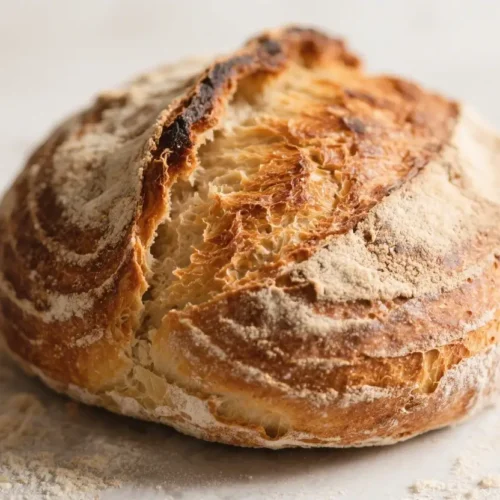
Finish uncovered. Remove the lid and bake another 18–25 minutes until deep golden-brown.
The loaf should register around 207–210°F (97–99°C) inside and feel light for its size.
Cool completely. Lift the bread out and cool on a rack for at least 1 hour. This sets the crumb and keeps it from turning gummy. You’ll hear the crust crackle as it cools—that’s your reward.