
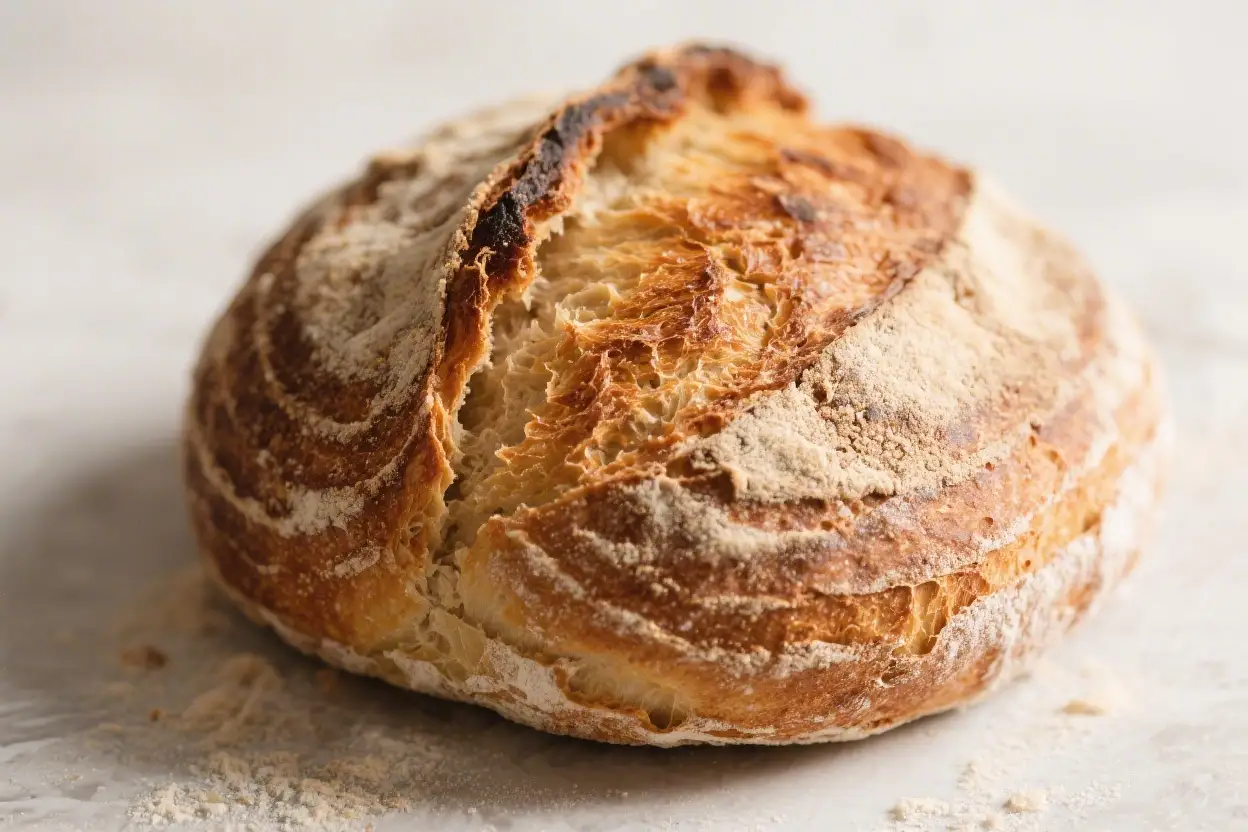
There’s nothing like pulling a crackling, golden boule from your oven and letting it sing as it cools. This rustic round loaf looks impressive but is actually simple and forgiving. You’ll get a crisp, blistered crust and a tender, open crumb that’s perfect for butter, soup, or sandwiches.
With a few pantry staples and a little time, you can bake a bakery-worthy loaf at home. Let’s keep it relaxed, practical, and delicious.
Why This Recipe Works
This recipe leans on a slow rise and high hydration to build flavor and texture. A wet dough creates that signature chewy interior and helps form a thin, crackly crust.
Baking in a covered pot traps steam, which keeps the surface moist so the loaf can rise fully before crisping. Simple shaping and a gentle hand preserve the air pockets, giving you that rustic, open crumb. The result is a loaf that looks artisanal without demanding complicated techniques.
What You’ll Need
- 3 1/4 cups (400 g) bread flour (or a mix of 300 g bread flour + 100 g whole wheat for a nuttier flavor)
- 1 1/2 cups (360 g) warm water (around 95–100°F / 35–38°C)
- 2 teaspoons (10 g) fine sea salt
- 1/2 teaspoon (2 g) instant yeast (or active dry yeast, bloomed in the warm water)
- Optional: 1 tablespoon olive oil for a touch of softness
- Dusting: extra flour or rice flour for the surface and proofing basket
- Equipment: large bowl, dough scraper, kitchen towel, parchment paper, and a Dutch oven or heavy lidded pot (4–6 quart)
How to Make It
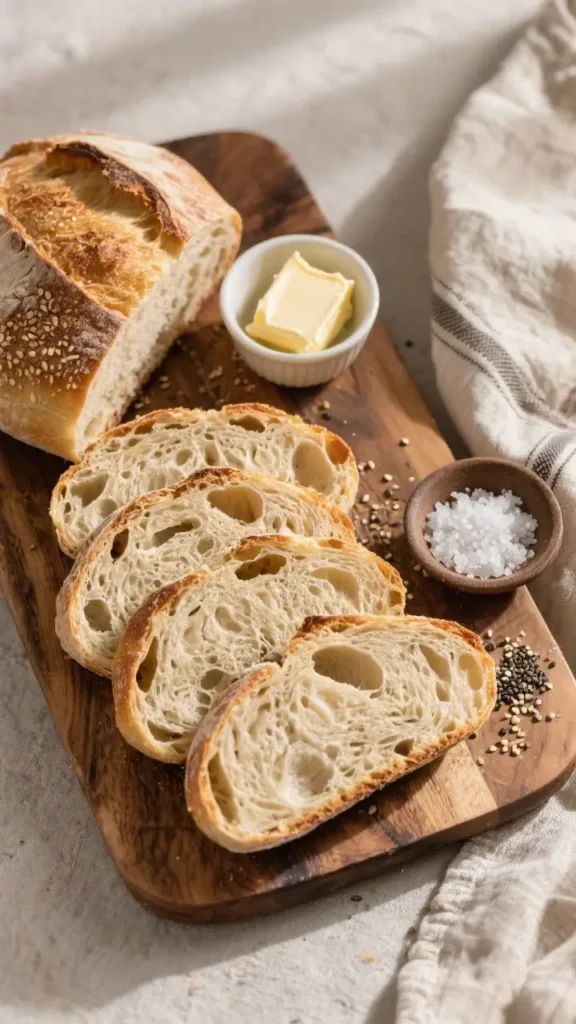
- Mix the dough. In a large bowl, whisk flour, salt, and yeast.
Add warm water (and olive oil if using). Stir with a spoon or hand until no dry flour remains. The dough will be shaggy and sticky—perfect.
- Rest to hydrate (autolyse). Cover the bowl and let the dough sit for 20–30 minutes.
This short rest makes the dough smoother and easier to handle without heavy kneading.
- Strengthen the dough with folds. Wet your hand, then perform 4–6 stretch-and-folds: grab one edge, stretch it up, and fold it over the center. Rotate the bowl and repeat. Do this once every 20–30 minutes for 3 rounds.
You’ll feel it tighten and gain strength.
- First rise (bulk fermentation). Cover the bowl and let it rise at room temperature until almost doubled, about 1 1/2 to 2 1/2 hours, depending on your kitchen temperature. The dough should look puffed with small bubbles.
- Pre-shape gently. Lightly flour your counter. Tip the dough out and, using a scraper, tuck the edges toward the center to form a loose round.
Let it rest, seam-side down, for 15–20 minutes to relax.
- Final shape. Flip the dough seam-side up. Gently stretch and fold the top, bottom, left, and right toward the center to create surface tension. Flip seam-side down and use your hands to rotate the ball, dragging slightly to tighten into a smooth boule.
- Proof. Place the boule seam-side up in a well-floured proofing basket or a bowl lined with a floured kitchen towel.
Cover and let it rise at room temperature until puffy and slightly springy, about 45–75 minutes. A fingertip poke should slowly spring back, leaving a light dent.
- Preheat with steam in mind. While the dough proofs, place your Dutch oven (with lid) on the center rack and preheat to 475°F (245°C) for at least 30 minutes. A hot pot gives you great oven spring.
- Score for expansion. Turn the dough onto parchment, seam-side down.
Dust lightly with flour. Using a sharp lame or knife, score a 1/4-inch deep cross or crescent to direct the rise.
- Bake covered. Carefully remove the hot pot, lift the parchment with the dough into it, cover, and bake for 20 minutes. The lid traps steam for a glossy, blistered crust.
- Finish uncovered. Remove the lid and bake another 18–25 minutes until deep golden-brown.
The loaf should register around 207–210°F (97–99°C) inside and feel light for its size.
- Cool completely. Lift the bread out and cool on a rack for at least 1 hour. This sets the crumb and keeps it from turning gummy. You’ll hear the crust crackle as it cools—that’s your reward.
Keeping It Fresh
Store your boule at room temperature, cut side down on a cutting board, for up to 24 hours.
After that, wrap it in a clean towel or place it in a paper bag to preserve the crust while preventing it from drying out. Avoid plastic unless you prefer a softer crust. For longer storage, slice and freeze in a zip-top bag; reheat slices in a toaster or the whole loaf in a 350°F (175°C) oven for 10–12 minutes to revive the crust.
Health Benefits
- Simple ingredients: Flour, water, yeast, and salt—no additives or preservatives.
- Slow fermentation: The resting time makes gluten easier to digest for some people and builds natural flavor without extra sugar.
- Whole grain option: Swapping in some whole wheat adds fiber, minerals, and a deeper taste.
- Portion-friendly: A hearty, chewy crumb is satisfying, so smaller slices can still feel filling.
What Not to Do
- Don’t rush the rise. Under-proofed dough won’t open up properly and may burst at random spots.
- Don’t add too much flour. Sticky dough is normal.
Over-flouring makes a dense, dry loaf.
- Don’t skip the preheat. A blazing-hot pot and oven are key to crispy crust and strong oven spring.
- Don’t slice while hot. Cutting too soon compresses the crumb and makes it gummy.
- Don’t store in the fridge. Refrigeration stales bread faster. Freeze instead if you need more time.
Recipe Variations
- Country Wheat Boule: Use 60% bread flour and 40% whole wheat. Add 1–2 tablespoons honey for balance and a slightly softer crumb.
- Seeded Crust: Roll the shaped boule in a mix of sesame, poppy, and sunflower seeds before proofing for extra crunch and flavor.
- Garlic and Herb: Fold in 2 teaspoons chopped rosemary or thyme and 3–4 roasted garlic cloves during the first set of folds.
- Olive Boule: Gently fold in 1/2 cup chopped, well-drained olives after the autolyse.
Reduce added salt slightly to compensate.
- Sourdough Hybrid: Replace 100 g water and 100 g flour with 200 g active sourdough starter. Use 1/8 teaspoon yeast to keep timing predictable.
Explore more irresistible bread recipes you won’t want to miss:
FAQ
Can I make this without a Dutch oven?
Yes. Preheat a baking stone or heavy sheet pan.
Place a metal pan on a lower rack and add a cup of boiling water when you put in the loaf to create steam. Bake until deeply colored, rotating once if needed.
Why is my crust soft after cooling?
Trapped steam can soften the crust as the bread cools. To keep it crisp, let the loaf cool on a wire rack with plenty of airflow.
You can also return it to a 375°F (190°C) oven for 5–8 minutes to re-crisp.
My dough is very sticky. Did I do something wrong?
Likely not. This is a higher hydration dough, so stickiness is normal.
Lightly wetting your hands, using a scraper, and keeping extra flour to a minimum will make it easier to handle without drying it out.
How do I know the bread is fully baked?
Look for a deep golden-brown crust and a hollow sound when you tap the bottom. An instant-read thermometer should show around 207–210°F (97–99°C) in the center. If in doubt, give it 5 more minutes uncovered.
Can I do an overnight rise?
Absolutely.
After mixing and the first set of folds, cover and refrigerate the dough for 8–16 hours. Shape cold, proof slightly longer, and bake as directed. The flavor will be deeper and the crumb nicely open.
What flour works best?
Bread flour gives the most reliable structure and chew.
All-purpose flour also works but may produce a slightly softer loaf. Mixing in 10–25% whole wheat adds flavor and nutrition without sacrificing rise.
How should I slice a boule?
Use a sharp serrated bread knife. For sandwiches, slice across the center into even pieces.
For rustic wedges, cut the loaf in half, then slice each half into arcs to preserve the crust.
Can I double the recipe?
Yes, but bake as two separate loaves for best results. Larger loaves can bake unevenly and may not crisp as well. Stagger the baking or use two pots if you have them.
Final Thoughts
A rustic boule doesn’t need fancy moves—just time, heat, and a gentle touch.
With this method, you’ll get a crackly crust, an airy crumb, and a loaf that fits any meal from breakfast to dinner. Once you’ve baked it once or twice, adjust the flour blend, add seeds or herbs, and make it your own. Keep it simple, trust the process, and enjoy the sound of a crust that tells you it’s perfect.
Homemade Rustic Boule Crispy Crust Bread Recipe – Simple, Cozy, and Satisfying
Ingredients
- 3 1/4 cups (400 g) bread flour (or a mix of 300 g bread flour + 100 g whole wheat for a nuttier flavor)
- 1 1/2 cups (360 g) warm water (around 95–100°F / 35–38°C)
- 2 teaspoons (10 g) fine sea salt
- 1/2 teaspoon (2 g) instant yeast (or active dry yeast, bloomed in the warm water)
- Optional: 1 tablespoon olive oil for a touch of softness
- Dusting: extra flour or rice flour for the surface and proofing basket
- Equipment: large bowl, dough scraper, kitchen towel, parchment paper, and a Dutch oven or heavy lidded pot (4–6 quart)
Instructions
- Mix the dough. In a large bowl, whisk flour, salt, and yeast.Add warm water (and olive oil if using). Stir with a spoon or hand until no dry flour remains. The dough will be shaggy and sticky—perfect.
- Rest to hydrate (autolyse). Cover the bowl and let the dough sit for 20–30 minutes.This short rest makes the dough smoother and easier to handle without heavy kneading.
- Strengthen the dough with folds. Wet your hand, then perform 4–6 stretch-and-folds: grab one edge, stretch it up, and fold it over the center. Rotate the bowl and repeat. Do this once every 20–30 minutes for 3 rounds.You’ll feel it tighten and gain strength.
- First rise (bulk fermentation). Cover the bowl and let it rise at room temperature until almost doubled, about 1 1/2 to 2 1/2 hours, depending on your kitchen temperature. The dough should look puffed with small bubbles.
- Pre-shape gently. Lightly flour your counter. Tip the dough out and, using a scraper, tuck the edges toward the center to form a loose round.Let it rest, seam-side down, for 15–20 minutes to relax.
- Final shape. Flip the dough seam-side up. Gently stretch and fold the top, bottom, left, and right toward the center to create surface tension. Flip seam-side down and use your hands to rotate the ball, dragging slightly to tighten into a smooth boule.
- Proof. Place the boule seam-side up in a well-floured proofing basket or a bowl lined with a floured kitchen towel.Cover and let it rise at room temperature until puffy and slightly springy, about 45–75 minutes. A fingertip poke should slowly spring back, leaving a light dent.
- Preheat with steam in mind. While the dough proofs, place your Dutch oven (with lid) on the center rack and preheat to 475°F (245°C) for at least 30 minutes. A hot pot gives you great oven spring.
- Score for expansion. Turn the dough onto parchment, seam-side down.Dust lightly with flour. Using a sharp lame or knife, score a 1/4-inch deep cross or crescent to direct the rise.
- Bake covered. Carefully remove the hot pot, lift the parchment with the dough into it, cover, and bake for 20 minutes. The lid traps steam for a glossy, blistered crust.
- Finish uncovered. Remove the lid and bake another 18–25 minutes until deep golden-brown.The loaf should register around 207–210°F (97–99°C) inside and feel light for its size.
- Cool completely. Lift the bread out and cool on a rack for at least 1 hour. This sets the crumb and keeps it from turning gummy. You’ll hear the crust crackle as it cools—that’s your reward.