
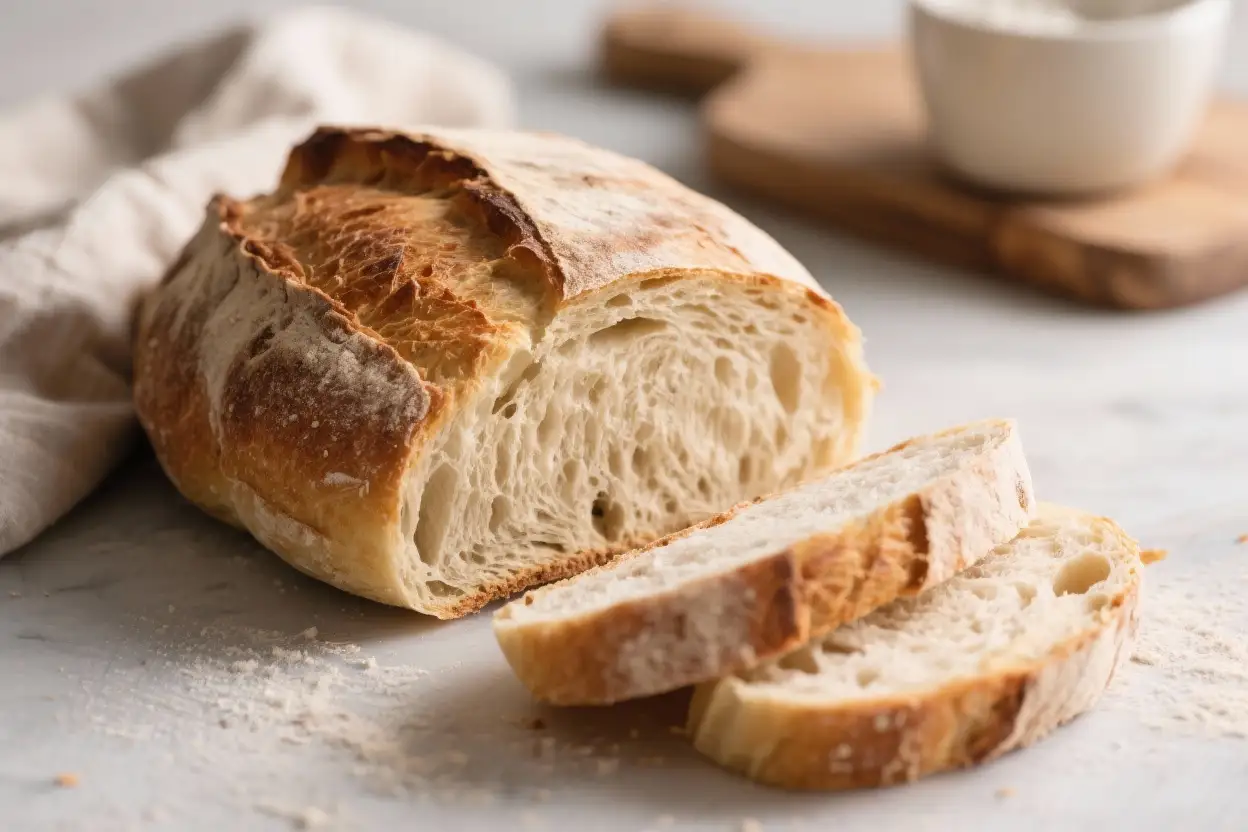
Making artisan bread at home sounds fancy, but it’s surprisingly simple. With just a few pantry staples and a bit of patience, you can bake a loaf that’s crusty on the outside and tender inside. The kind that cracks when you tear it and smells like a cozy bakery.
This recipe doesn’t need special equipment or complicated techniques. If you can stir, wait, and bake, you can make this bread. And once you do, you’ll want to make it every week.
What Makes This Recipe So Good
- Minimal ingredients: Just flour, water, salt, and yeast.
That’s it.
- No kneading: Time does the work for you. The long rest builds flavor and structure.
- Big flavor, amazing crust: You’ll get that classic artisan taste and a crisp, blistered crust.
- Flexible schedule: Make the dough in the evening, bake the next day. It fits into real life.
- Adaptable: Add herbs, seeds, or cheese if you want to switch it up.
Shopping List
- All-purpose flour (or bread flour), about 3 1/4 cups (400 g)
- Warm water, 1 1/2 cups (360 ml), around 95–100°F (lukewarm)
- Instant or active dry yeast, 1/2 teaspoon
- Fine sea salt, 1 1/4 teaspoons
- Cornmeal or extra flour for dusting
- Optional add-ins: 1–2 teaspoons sugar or honey, fresh herbs, garlic, seeds, or shredded cheese
Step-by-Step Instructions
- Mix the dough: In a large bowl, whisk flour, salt, and yeast.
Pour in warm water and stir with a spoon until a shaggy, sticky dough forms. It won’t look smooth. That’s perfect.
- First rise (long rest): Cover the bowl with plastic wrap or a clean towel.
Let it rest at room temperature for 12–18 hours. You’ll know it’s ready when the surface is dotted with bubbles and the dough has doubled.
- Prepare your surface: Lightly flour your counter. Scrape the dough out gently with a spatula.
Try not to deflate it too much.
- Shape the dough: Dust your hands with flour. Fold the dough edges toward the center a few times to make a loose ball. Don’t overwork it.
The dough should stay soft and airy.
- Second rise: Place the dough seam-side down on a piece of parchment or a floured towel. Dust the top with flour. Cover and let rise for 45–60 minutes, until puffy and slightly domed.
- Preheat the oven and pot: About 30 minutes before baking, put a Dutch oven (with lid) in your oven and preheat to 450°F (230°C).
A preheated pot gives you that crisp, crackly crust.
- Score the top: If you like, use a sharp knife or razor to make a shallow slit on top. This helps control the expansion in the oven.
- Transfer to the pot: Carefully remove the hot Dutch oven. Lift the dough using the parchment and place it inside.
Cover with the lid.
- Bake covered: Bake for 30 minutes with the lid on. The trapped steam helps the bread rise and form a glossy crust.
- Finish uncovered: Remove the lid and bake another 12–18 minutes, until deep golden brown and crackly. The loaf should sound hollow when tapped on the bottom.
- Cool completely: Transfer to a rack and let cool at least 45–60 minutes before slicing.
This sets the crumb and keeps it moist.
- Serve: Slice and enjoy with butter, olive oil, soup, or anything you love. It’s excellent toasted the next day.
Storage Instructions
- Room temperature: Keep the loaf in a paper bag or wrapped in a clean towel for up to 2 days. Avoid sealing in plastic, which softens the crust.
- Freeze: Slice, then freeze in a zip-top bag for up to 2 months.
Toast straight from frozen, or thaw at room temp.
- Refresh the crust: If the crust softens, place the loaf in a 350°F (175°C) oven for 8–10 minutes to crisp it back up.
Benefits of This Recipe
- Reliable results: The long rest and covered bake make success likely even for beginners.
- Budget-friendly: Costs pennies per slice, yet tastes like a bakery loaf.
- Better ingredients: You control the salt, add-ins, and flour quality.
- Naturally vegan: With just flour, water, yeast, and salt, it fits many diets.
- Flexible flavor: Add rosemary, olives, roasted garlic, or seeds to suit your menu.
Common Mistakes to Avoid
- Water too hot: Very hot water can kill yeast. Aim for warm, not hot—about body temperature.
- Under-rising: If the dough hasn’t doubled and looks flat, give it more time. Cooler rooms need longer.
- Over-flouring: Sticky dough is normal.
Add just enough flour to handle. Too much makes the loaf dense.
- Skipping the preheat: A fully heated Dutch oven and oven are key for oven spring and crust.
- Cutting too soon: Let it cool. Slicing hot bread compresses the crumb and makes it gummy.
Alternatives
- No Dutch oven: Use a heavy baking sheet or stone.
Preheat a metal pan on the lower rack and pour in a cup of hot water when the bread goes in to create steam. Bake 35–45 minutes until deeply golden.
- Whole wheat version: Swap 25–30% of the flour for whole wheat. Add 1–2 tablespoons extra water if needed.
Expect a slightly tighter crumb and nuttier flavor.
- Overnight cold proof: After the first rise, refrigerate the dough up to 24 hours. This deepens flavor and helps with scheduling.
- Gluten-free swap: Use a high-quality gluten-free bread flour blend and add 1 teaspoon apple cider vinegar. Texture will differ, but you’ll still get a nice crust.
- Flavor add-ins: Fold in 1/2–3/4 cup shredded cheese, chopped olives, or roasted garlic during shaping.
Keep add-ins dry and well distributed.
Explore more irresistible bread recipes you won’t want to miss:
FAQ
Can I use active dry yeast instead of instant?
Yes. If using active dry yeast, dissolve it in the warm water with a pinch of sugar and let sit for 5–10 minutes until foamy, then mix into the flour and salt. The rest of the method is the same.
How do I know when the bread is fully baked?
Look for a deep golden crust and a hollow sound when you tap the bottom.
If you have an instant-read thermometer, the center should be around 205–210°F (96–99°C).
Why is my bread dense?
Common causes include adding too much flour, short rise times, or a cool dough environment. Keep the dough wetter than you think, and allow it to rise until puffy and bubbly, not just by the clock.
What flour is best?
All-purpose flour works great and keeps the crumb tender. Bread flour gives a chewier texture and slightly more rise.
Both are good; use what you have.
Can I double the recipe?
Yes. Use a larger bowl and a 6–7 quart Dutch oven, or bake two smaller loaves one after the other. Rising time stays similar; baking time may increase by a few minutes for a larger loaf.
Do I have to score the dough?
No.
Scoring helps control where the loaf expands, but an unscored loaf will still open naturally. If you skip it, handle the dough gently to keep the surface tension.
How can I get a thinner, cracklier crust?
Bake with steam (covered pot or water in a hot pan) and let the loaf finish uncovered until deeply golden. A longer uncovered finish crisps and thins the crust.
What if I don’t have parchment paper?
Dust the pot with cornmeal or flour and carefully place the shaped dough directly inside.
Work quickly and use oven mitts since the pot is very hot.
Wrapping Up
This artisan bread is simple, forgiving, and incredibly satisfying. With a little time and a hot oven, you’ll get a loaf that looks and tastes like it came from a bakery. Keep the ingredients basic, be patient with the rises, and let the oven do the rest.
Once you master this, you can tweak flavors and textures to match any meal. Happy baking—your kitchen is about to smell amazing.
The Best Artisan Bread You Can Make at Home – Simple, Crusty, and Foolproof
Ingredients
- All-purpose flour (or bread flour), about 3 1/4 cups (400 g)
- Warm water, 1 1/2 cups (360 ml), around 95–100°F (lukewarm)
- Instant or active dry yeast, 1/2 teaspoon
- Fine sea salt, 1 1/4 teaspoons
- Cornmeal or extra flour for dusting
- Optional add-ins: 1–2 teaspoons sugar or honey, fresh herbs, garlic, seeds, or shredded cheese
Instructions
- Mix the dough: In a large bowl, whisk flour, salt, and yeast.Pour in warm water and stir with a spoon until a shaggy, sticky dough forms. It won’t look smooth. That’s perfect.
- First rise (long rest): Cover the bowl with plastic wrap or a clean towel.Let it rest at room temperature for 12–18 hours. You’ll know it’s ready when the surface is dotted with bubbles and the dough has doubled.
- Prepare your surface: Lightly flour your counter. Scrape the dough out gently with a spatula.Try not to deflate it too much.
- Shape the dough: Dust your hands with flour. Fold the dough edges toward the center a few times to make a loose ball. Don’t overwork it.The dough should stay soft and airy.
- Second rise: Place the dough seam-side down on a piece of parchment or a floured towel. Dust the top with flour. Cover and let rise for 45–60 minutes, until puffy and slightly domed.
- Preheat the oven and pot: About 30 minutes before baking, put a Dutch oven (with lid) in your oven and preheat to 450°F (230°C).A preheated pot gives you that crisp, crackly crust.
- Score the top: If you like, use a sharp knife or razor to make a shallow slit on top. This helps control the expansion in the oven.
- Transfer to the pot: Carefully remove the hot Dutch oven. Lift the dough using the parchment and place it inside.Cover with the lid.
- Bake covered: Bake for 30 minutes with the lid on. The trapped steam helps the bread rise and form a glossy crust.
- Finish uncovered: Remove the lid and bake another 12–18 minutes, until deep golden brown and crackly. The loaf should sound hollow when tapped on the bottom.
- Cool completely: Transfer to a rack and let cool at least 45–60 minutes before slicing.This sets the crumb and keeps it moist.
- Serve: Slice and enjoy with butter, olive oil, soup, or anything you love. It’s excellent toasted the next day.