
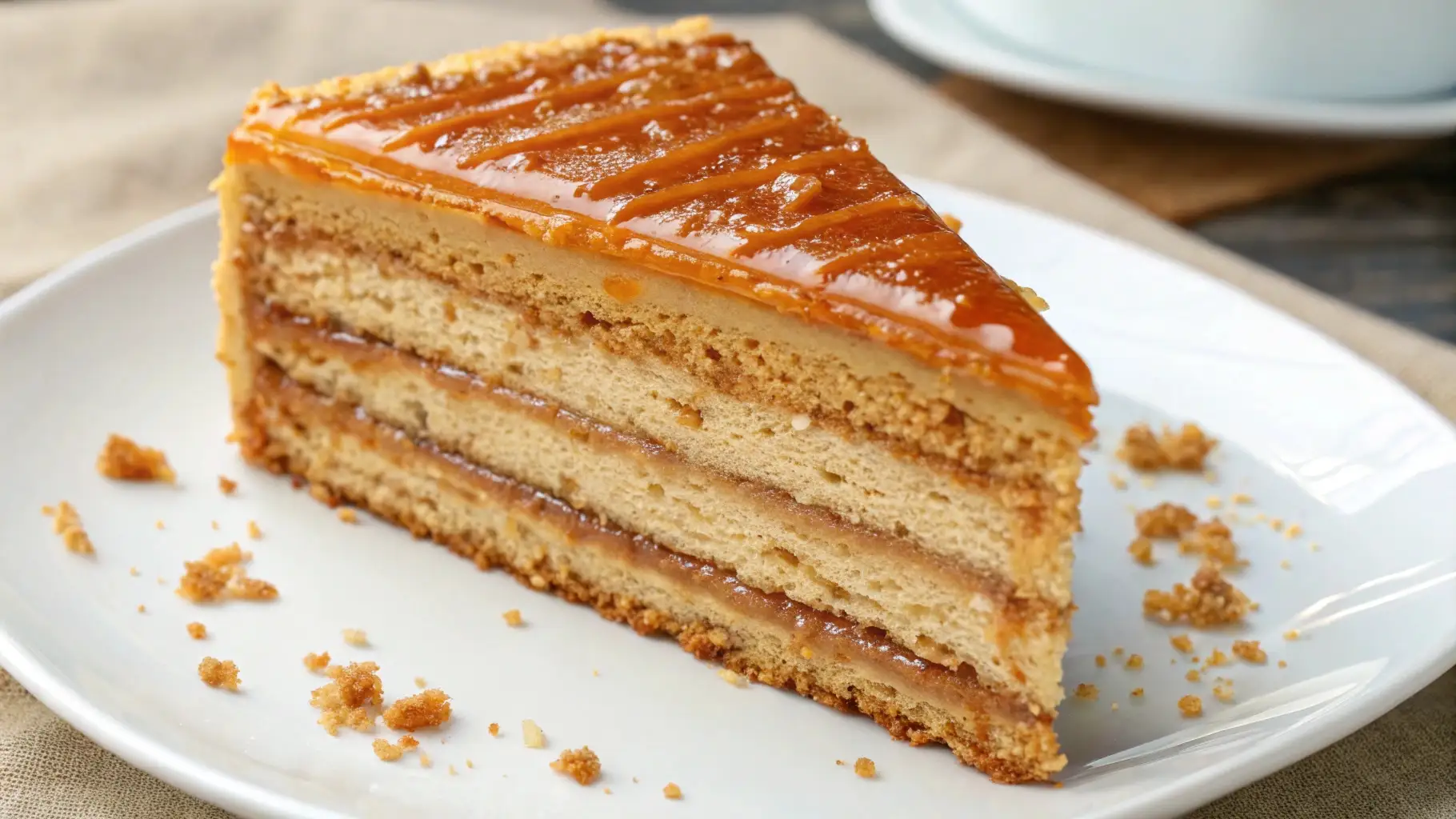
Russian honey cake is the kind of dessert that makes people pause after the first bite. It’s tender, layered, and just sweet enough, with a deep, toasty flavor that comes from caramelized honey. The texture is soft but structured—like a cookie that transforms into cake after resting with cream.
It’s nostalgic if you grew up around it, and a revelation if you didn’t. The best part: once you learn the flow, it’s far easier than it looks.
What Makes This Special
Traditional honey cakes often taste sweet but one-note. This version uses caramelized honey, which brings a warm, slightly smoky depth that balances the cream.
Instead of heavy frosting, we use a light sour cream or crème fraîche filling that keeps the layers moist and tangy.
It also uses thin, rollable dough layers that bake quickly and soften as the cake rests overnight. The final result is a cake that slices cleanly and melts in your mouth. Simple ingredients, classic technique, big payoff.
Shopping List
- Honey (1/2 cup for caramelizing, plus 2–3 tablespoons for the cream if desired)
- Granulated sugar (3/4 cup)
- Unsalted butter (6 tablespoons)
- Large eggs (3)
- All-purpose flour (about 3–3 1/2 cups; start with 3 and add as needed)
- Baking soda (1 1/2 teaspoons)
- Fine salt (1/2 teaspoon)
- Vanilla extract (1 teaspoon)
- Sour cream (4 cups) or a mix of sour cream and heavy cream (3 cups sour cream + 1 cup heavy cream)
- Powdered sugar (1/2–3/4 cup, to taste)
- Lemon zest or juice (optional, a little brightens the cream)
Instructions
- Caramelize the honey: In a medium saucepan over medium heat, cook 1/2 cup honey, stirring occasionally, until it deepens to a bronze amber and smells toasty, 3–5 minutes.
It may foam; keep an eye on it. Remove from heat and carefully whisk in 6 tablespoons butter until melted.
- Add sugar and dissolve: Stir in 3/4 cup granulated sugar. Return to low heat and stir until the sugar dissolves.
Take off the heat and let it cool for 2–3 minutes so it’s warm, not scorching.
- Whisk in eggs: In a large bowl, whisk the 3 eggs. Slowly stream in the warm honey mixture while whisking constantly so the eggs don’t scramble.
- Activate baking soda: Stir in 1 1/2 teaspoons baking soda and 1/2 teaspoon salt. The mixture will lighten and slightly foam.
Add 1 teaspoon vanilla.
- Make the dough: Add 3 cups all-purpose flour in stages, folding with a spatula until a soft, slightly sticky dough forms. If needed, add up to 1/2 cup more flour. It should hold together but still feel supple.
- Rest briefly: Cover the dough and let it sit 10–15 minutes.
This helps it roll without cracking.
- Preheat and prep: Heat oven to 350°F (175°C). Line 3 baking sheets with parchment. Draw 8-inch (20 cm) circles on the parchment as guides, then flip the paper so the pencil side faces down.
- Divide and roll: Divide dough into 8–10 equal pieces.
Dust a surface lightly. Roll each piece into a thin round that fits your guide, about 1/8 inch thick or slightly thinner. Transfer to prepared sheets.
- Bake the layers: Bake 2–3 layers at a time for 5–8 minutes, until edges are golden and centers set.
If you want perfectly even rounds, place an 8-inch plate over the hot layer and trim immediately; save the scraps for crumbs.
- Cool completely: Let layers cool on racks. They will be firm, like cookies—don’t worry, the cream will soften them.
- Make the cream: In a bowl, whisk 4 cups sour cream with 1/2–3/4 cup powdered sugar until smooth and slightly thick. Add 1–2 tablespoons caramelized honey (optional) and a pinch of lemon zest or a squeeze of juice for brightness.
If using heavy cream, whip it to soft peaks and fold into the sweetened sour cream for extra lightness.
- Assemble: Place the first layer on a serving plate. Spread a generous scoop of cream evenly, reaching the edges. Repeat with all layers, keeping the top neat.
The cream should be slightly soft; it will firm up as it chills.
- Crumb coat: Pulse the baked trimmings into fine crumbs. Press them around the sides and sprinkle over the top for a classic look and extra texture.
- Rest the cake: Cover loosely and chill at least 8 hours, ideally overnight. The layers will soften, and the flavors will meld.
- Serve: Slice with a sharp knife, wiping between cuts.
The cake keeps improving on day two.
Keeping It Fresh
Store the cake covered in the refrigerator for up to 5 days. The layers stay moist and the flavor deepens. For the best texture, let slices sit at room temperature for 15–20 minutes before serving.
You can freeze individual slices, tightly wrapped, for up to 1 month.
Thaw overnight in the fridge. Avoid freezing the unassembled cream, as the texture can separate.
Health Benefits
- Honey has natural antioxidants that can help reduce oxidative stress, especially when not overheated. Caramelizing does reduce some benefits but adds complex flavor.
- Sour cream provides calcium and some protein.
Using part yogurt or Greek yogurt can boost protein and probiotics.
- Portion control matters with desserts. A thin slice satisfies thanks to the layered texture and balanced sweetness.
While this isn’t a “health food,” choosing quality ingredients and mindful portions lets you enjoy it without overdoing it.
Common Mistakes to Avoid
- Over-caramelizing the honey: Dark amber is good; blackened is bitter. Stay nearby and trust your nose.
- Scrambling the eggs: Temper the eggs by whisking in the warm honey mixture slowly.
If steam is rising aggressively, wait another minute.
- Adding too much flour: The dough should be soft. Extra flour makes layers tough and dry. Dust lightly when rolling instead of kneading in more flour.
- Baking too long: Thin layers bake fast.
Pull them when edges are golden. Overbaking makes them brittle and harder to soften later.
- Skipping the rest time: The overnight rest is what turns crisp layers into a tender cake. Don’t rush this step.
- Watery cream: If your sour cream is very loose, strain it for 30–60 minutes, or fold in lightly whipped cream to stabilize.
Alternatives
- Filling options: Use a 50/50 mix of sour cream and mascarpone for a richer, thicker filling.
Or try crème fraîche for subtle tang and silkiness.
- Flavor twist: Add a pinch of cinnamon or a scrape of vanilla bean to the cream. Grated orange zest pairs beautifully with honey.
- Sugar swaps: You can use light brown sugar in the dough for added caramel notes. Keep the powdered sugar in the cream for smoothness.
- Gluten-free: A good 1:1 gluten-free flour blend with xanthan gum can work.
Roll gently and bake on parchment to avoid tearing.
- Decoration: Finish with walnut crumbs or toasted hazelnuts instead of cake crumbs. A drizzle of warm honey right before serving adds shine.
Explore more irresistible cake recipes you won’t want to miss:
FAQ
Do I need a double boiler for the dough?
No. Many traditional recipes use one, but as long as you keep the honey mixture warm—not scalding—you can mix in a regular bowl without scrambling the eggs.
Can I make the layers ahead?
Yes.
Bake and cool the layers, then store them airtight at room temperature for up to 2 days. Assemble and chill overnight before serving.
What if my dough cracks when rolling?
Let it rest a bit longer and roll on lightly floured parchment. You can also patch cracks with scraps—once baked and layered with cream, you won’t notice.
How many layers should I make?
Eight is classic, but anywhere between 6 and 10 works.
Thinner layers give a more refined texture; thicker layers make a heartier slice.
Is the cake very sweet?
No. The caramelized honey brings depth, and the sour cream keeps the sweetness in check. Adjust the powdered sugar in the cream to your taste.
Can I use Greek yogurt instead of sour cream?
Yes, preferably full-fat.
For the best texture, mix 3 parts yogurt with 1 part lightly whipped cream or mascarpone to prevent a chalky feel.
How do I get clean slices?
Chill the cake well, then use a sharp, thin knife. Wipe the blade between cuts and use a gentle sawing motion.
Final Thoughts
Authentic Russian Honey Cake with caramelized honey is about contrast—deep, toasty layers wrapped in cool, tangy cream. It looks impressive, but once you’ve made it once, it becomes a reliable, crowd-pleasing favorite.
Give it a proper overnight rest, slice with patience, and let the cake do the talking. It tastes like tradition, with an elegant twist you’ll want to make again and again.
Authentic Russian Honey Cake with Caramelized Honey – Layered, Cozy, and Perfectly Balanced
Ingredients
- Honey (1/2 cup for caramelizing, plus 2–3 tablespoons for the cream if desired)
- Granulated sugar (3/4 cup)
- Unsalted butter (6 tablespoons)
- Large eggs (3)
- All-purpose flour (about 3–3 1/2 cups; start with 3 and add as needed)
- Baking soda (1 1/2 teaspoons)
- Fine salt (1/2 teaspoon)
- Vanilla extract (1 teaspoon)
- Sour cream (4 cups) or a mix of sour cream and heavy cream (3 cups sour cream + 1 cup heavy cream)
- Powdered sugar (1/2–3/4 cup, to taste)
- Lemon zest or juice (optional, a little brightens the cream)
Instructions
- Caramelize the honey: In a medium saucepan over medium heat, cook 1/2 cup honey, stirring occasionally, until it deepens to a bronze amber and smells toasty, 3–5 minutes.It may foam; keep an eye on it. Remove from heat and carefully whisk in 6 tablespoons butter until melted.
- Add sugar and dissolve: Stir in 3/4 cup granulated sugar. Return to low heat and stir until the sugar dissolves.Take off the heat and let it cool for 2–3 minutes so it’s warm, not scorching.
- Whisk in eggs: In a large bowl, whisk the 3 eggs. Slowly stream in the warm honey mixture while whisking constantly so the eggs don’t scramble.
- Activate baking soda: Stir in 1 1/2 teaspoons baking soda and 1/2 teaspoon salt. The mixture will lighten and slightly foam.Add 1 teaspoon vanilla.
- Make the dough: Add 3 cups all-purpose flour in stages, folding with a spatula until a soft, slightly sticky dough forms. If needed, add up to 1/2 cup more flour. It should hold together but still feel supple.
- Rest briefly: Cover the dough and let it sit 10–15 minutes.This helps it roll without cracking.
- Preheat and prep: Heat oven to 350°F (175°C). Line 3 baking sheets with parchment. Draw 8-inch (20 cm) circles on the parchment as guides, then flip the paper so the pencil side faces down.
- Divide and roll: Divide dough into 8–10 equal pieces.Dust a surface lightly. Roll each piece into a thin round that fits your guide, about 1/8 inch thick or slightly thinner. Transfer to prepared sheets.
- Bake the layers: Bake 2–3 layers at a time for 5–8 minutes, until edges are golden and centers set.If you want perfectly even rounds, place an 8-inch plate over the hot layer and trim immediately; save the scraps for crumbs.
- Cool completely: Let layers cool on racks. They will be firm, like cookies—don’t worry, the cream will soften them.
- Make the cream: In a bowl, whisk 4 cups sour cream with 1/2–3/4 cup powdered sugar until smooth and slightly thick. Add 1–2 tablespoons caramelized honey (optional) and a pinch of lemon zest or a squeeze of juice for brightness.If using heavy cream, whip it to soft peaks and fold into the sweetened sour cream for extra lightness.
- Assemble: Place the first layer on a serving plate. Spread a generous scoop of cream evenly, reaching the edges. Repeat with all layers, keeping the top neat.The cream should be slightly soft; it will firm up as it chills.
- Crumb coat: Pulse the baked trimmings into fine crumbs. Press them around the sides and sprinkle over the top for a classic look and extra texture.
- Rest the cake: Cover loosely and chill at least 8 hours, ideally overnight. The layers will soften, and the flavors will meld.
- Serve: Slice with a sharp knife, wiping between cuts.The cake keeps improving on day two.