
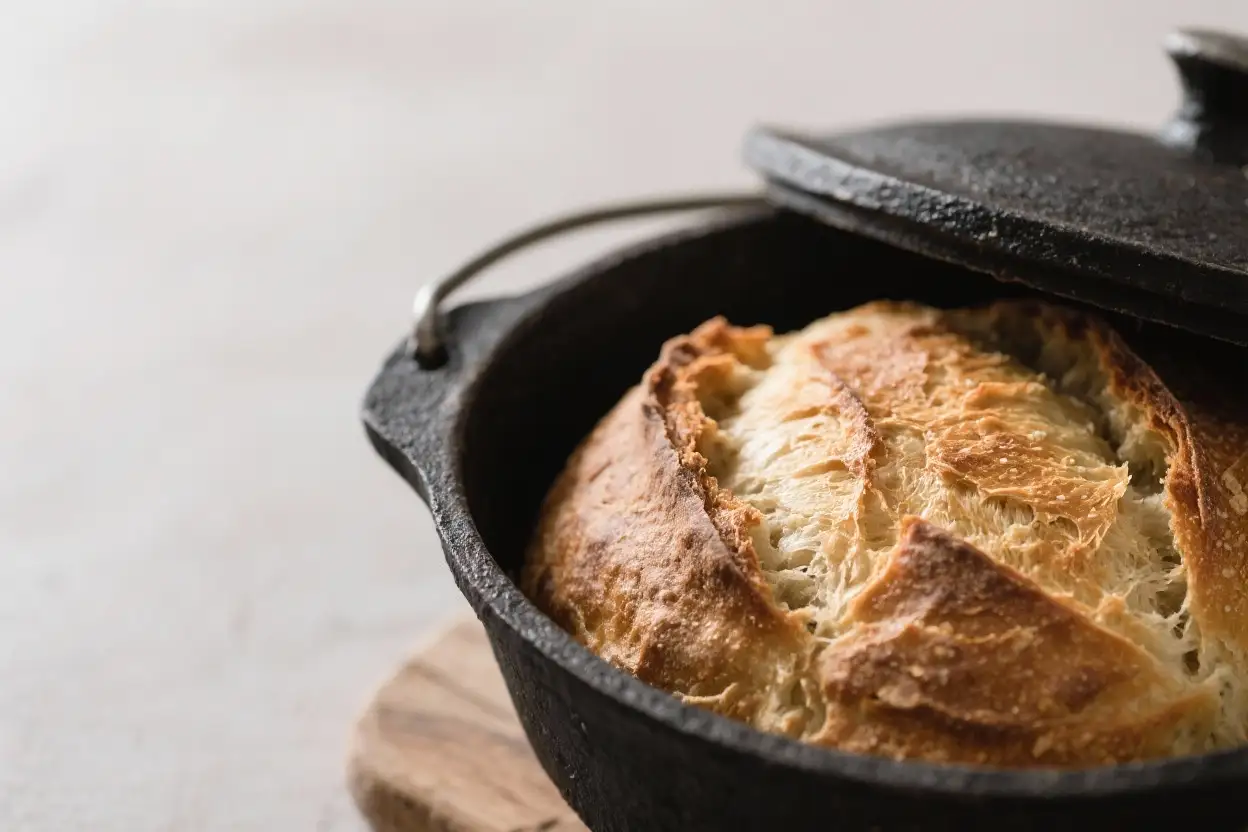
If you’ve always wanted to bake bread but felt intimidated, this is your entry point. Dutch oven bread is famous for its crackly crust, soft interior, and straightforward method. No special equipment beyond a heavy pot, no complicated steps, and no kneading for ages.
You’ll mix the dough in minutes, let time do the work, and bake it in a preheated pot that acts like a mini bakery oven. The result is a golden, rustic loaf that makes your kitchen smell incredible and your first slice unforgettable.
What Makes This Special
This bread is beginner-friendly because it uses a “no-knead” approach. The long rest lets gluten develop naturally, so you get a chewy crumb without elbow grease.
The Dutch oven traps steam, creating that bakery-style crust without spritzing or special tools.
It’s also flexible: you can use all-purpose or bread flour, and the timings are forgiving.
Best of all, the ingredient list is short, affordable, and likely already in your pantry. In under 10 minutes of active work, you’ll have a loaf that looks and tastes like it came from an artisan shop.
Shopping List
- All-purpose or bread flour – 3 cups (360 g)
- Warm water – 1 1/2 cups (360 ml), about 100–110°F (lukewarm)
- Instant or active dry yeast – 1/2 teaspoon
- Fine sea salt – 1 1/4 teaspoons
- Olive oil (optional) – 1 teaspoon for added tenderness
- Cornmeal or flour for dusting
- Parchment paper (highly recommended for easy transfer)
Instructions
- Mix the dough. In a large bowl, whisk flour, salt, and yeast. Add warm water (and olive oil if using).
Stir with a spoon until no dry patches remain. The dough will be shaggy and sticky, and that’s perfect.
- First rise (hands-off). Cover the bowl tightly with plastic wrap or a lid. Let it rest at room temperature for 8–12 hours, or until doubled and puffy with small bubbles on the surface.
Cooler kitchens may need up to 14 hours, warmer ones closer to 6–8.
- Shape gently. Dust your counter and hands with flour. Scrape the dough out, sprinkle a little more flour on top, and fold it over itself 3–4 times to create a round. Avoid heavy kneading; you want to keep the air inside.
- Second rise. Set the dough seam-side down on a piece of parchment.
Lightly flour the top and cover with a towel. Let it rest 30–45 minutes, until slightly puffed.
- Preheat the Dutch oven. About 30 minutes before baking, place a 4–6 quart Dutch oven (with lid) in your oven and heat to 450°F (232°C). A hot pot is key for a great crust.
- Score the top. Use a sharp knife or razor to make a 1/2-inch deep slash across the top.
This guides the expansion and helps prevent random cracks.
- Transfer and bake covered. Carefully remove the hot Dutch oven. Lift the dough using the parchment and lower it into the pot. Cover and bake for 30 minutes.
The lid traps steam for maximum oven spring and crust formation.
- Finish uncovered. Remove the lid and bake 10–15 minutes more, until the crust is deep golden brown. For doneness, the internal temperature should be around 205–210°F (96–99°C).
- Cool before slicing. Lift the loaf out by the parchment and set it on a rack. Wait at least 45 minutes before cutting.
Cooling sets the crumb and keeps it from turning gummy.
- Serve. Slice with a serrated knife. Enjoy with butter, soup, or as a base for sandwiches.
Keeping It Fresh
Let the bread cool fully, then store it cut-side down on a board for the first day to preserve the crust. After that, keep it in a paper bag or wrapped in a clean kitchen towel at room temperature for up to 3 days.
Avoid plastic bags if you love a crisp crust—they trap moisture and soften it.
For longer storage, slice and freeze in a freezer bag for up to 2 months. Toast slices straight from the freezer. To refresh a whole loaf, warm it at 350°F (177°C) for 10–12 minutes.
Health Benefits
- Simple, recognizable ingredients. Flour, water, yeast, and salt—no additives or preservatives.
- Portion control is easy. A hearty loaf lets you slice to your needs, from thin to thick.
- Lower in fat and sugar. This recipe has no added sugar and only optional oil.
- Customizable nutrition. Swap in some whole wheat or add seeds for extra fiber, minerals, and healthy fats.
- Fermentation benefits. The long rise can make the bread more flavorful and potentially easier to digest for some people.
Pitfalls to Watch Out For
- Water too hot. Anything above 120°F can damage yeast.
Aim for warm, not hot.
- Rushing the rises. Under-proofed dough leads to dense bread. Wait for visible puffing and bubbles.
- Skipping the preheat. A cold Dutch oven won’t give you that oven spring and crisp crust.
- Over-flouring during shaping. Too much extra flour can toughen the loaf. Use just enough to handle the dough.
- Slicing too soon. Cutting hot bread compresses the crumb and makes it gummy.
Let it rest.
Recipe Variations
- Half Whole Wheat: Use 2 cups all-purpose and 1 cup whole wheat flour. Add an extra tablespoon or two of water if the dough feels stiff.
- Herb and Garlic: Mix in 1–2 teaspoons dried Italian herbs and 1 teaspoon garlic powder with the dry ingredients.
- Seeded Crust: After shaping, roll the dough in a mix of sesame, sunflower, and flax seeds. Press gently so they stick.
- Cheddar and Jalapeño: Fold in 1 cup shredded sharp cheddar and 1 finely chopped jalapeño during the initial mix.
- Everything Bagel Topping: Brush the dough lightly with water before the second rise and sprinkle with everything seasoning.
- Overnight Refrigerator Rise: After mixing, refrigerate the dough 12–18 hours for deeper flavor, then proceed with shaping and baking.
Explore more irresistible bread recipes you won’t want to miss:
FAQ
Can I use active dry yeast instead of instant?
Yes.
If using active dry yeast, you can whisk it into the warm water and let it sit 5–10 minutes until foamy, then mix with the dry ingredients. The rise time may be slightly longer, but the method is the same.
Do I need a Dutch oven with an enamel coating?
No. Any heavy, oven-safe pot with a tight lid works—enameled or bare cast iron.
Make sure it’s rated for at least 450°F and has a metal knob or handle.
What if my dough seems too wet?
Sticky dough is normal for no-knead bread. Resist adding lots of flour. Lightly dust your hands and the surface for shaping.
Wet dough usually bakes into a better crumb and crust.
How do I get bigger holes in the crumb?
Use a slightly higher hydration (add 1–2 tablespoons more water), handle the dough gently, and ensure a full first rise. Bread flour can also help by adding more gluten strength.
Can I double the recipe?
You can, but consider baking two separate loaves. A larger mass can crowd the Dutch oven and bake unevenly.
Two standard loaves give better results and crust.
Why did my crust get too dark?
All ovens vary. If the loaf browns quickly, reduce the final uncovered time or lower the temp to 425°F for the last 10 minutes. You can also tent the loaf loosely with foil after removing the lid.
Is parchment paper necessary?
It’s not mandatory, but it makes transferring the dough safer and prevents sticking.
If skipping parchment, dust the pot with cornmeal or flour before adding the dough.
Can I add sourdough starter?
Yes. Replace 1/2 cup of the water and 1/2 cup of the flour with active starter, and reduce yeast to a pinch. Expect longer rise times and a tangier flavor.
In Conclusion
This Easy Dutch Oven Bread Recipe for Beginners gives you a crisp crust, tender crumb, and reliable results with minimal effort.
With a few pantry staples, a warm spot, and a hot pot, you’ll bake a loaf that looks artisan and tastes even better. Keep the method the same, then play with variations when you’re ready. Once you’ve mastered this, you’ll find excuses to bake it every week—soups, sandwiches, or just warm slices with butter.
Easy Dutch Oven Bread Recipe for Beginners - Simple, Crusty, and Foolproof
Ingredients
- All-purpose or bread flour – 3 cups (360 g)
- Warm water – 1 1/2 cups (360 ml), about 100–110°F (lukewarm)
- Instant or active dry yeast – 1/2 teaspoon
- Fine sea salt – 1 1/4 teaspoons
- Olive oil (optional) – 1 teaspoon for added tenderness
- Cornmeal or flour for dusting
- Parchment paper (highly recommended for easy transfer)
Instructions
- Mix the dough. In a large bowl, whisk flour, salt, and yeast. Add warm water (and olive oil if using).Stir with a spoon until no dry patches remain. The dough will be shaggy and sticky, and that’s perfect.
- First rise (hands-off). Cover the bowl tightly with plastic wrap or a lid. Let it rest at room temperature for 8–12 hours, or until doubled and puffy with small bubbles on the surface.Cooler kitchens may need up to 14 hours, warmer ones closer to 6–8.
- Shape gently. Dust your counter and hands with flour. Scrape the dough out, sprinkle a little more flour on top, and fold it over itself 3–4 times to create a round. Avoid heavy kneading; you want to keep the air inside.
- Second rise. Set the dough seam-side down on a piece of parchment.Lightly flour the top and cover with a towel. Let it rest 30–45 minutes, until slightly puffed.
- Preheat the Dutch oven. About 30 minutes before baking, place a 4–6 quart Dutch oven (with lid) in your oven and heat to 450°F (232°C). A hot pot is key for a great crust.
- Score the top. Use a sharp knife or razor to make a 1/2-inch deep slash across the top.This guides the expansion and helps prevent random cracks.
- Transfer and bake covered. Carefully remove the hot Dutch oven. Lift the dough using the parchment and lower it into the pot. Cover and bake for 30 minutes.The lid traps steam for maximum oven spring and crust formation.
- Finish uncovered. Remove the lid and bake 10–15 minutes more, until the crust is deep golden brown. For doneness, the internal temperature should be around 205–210°F (96–99°C).
- Cool before slicing. Lift the loaf out by the parchment and set it on a rack. Wait at least 45 minutes before cutting.Cooling sets the crumb and keeps it from turning gummy.
- Serve. Slice with a serrated knife. Enjoy with butter, soup, or as a base for sandwiches.