
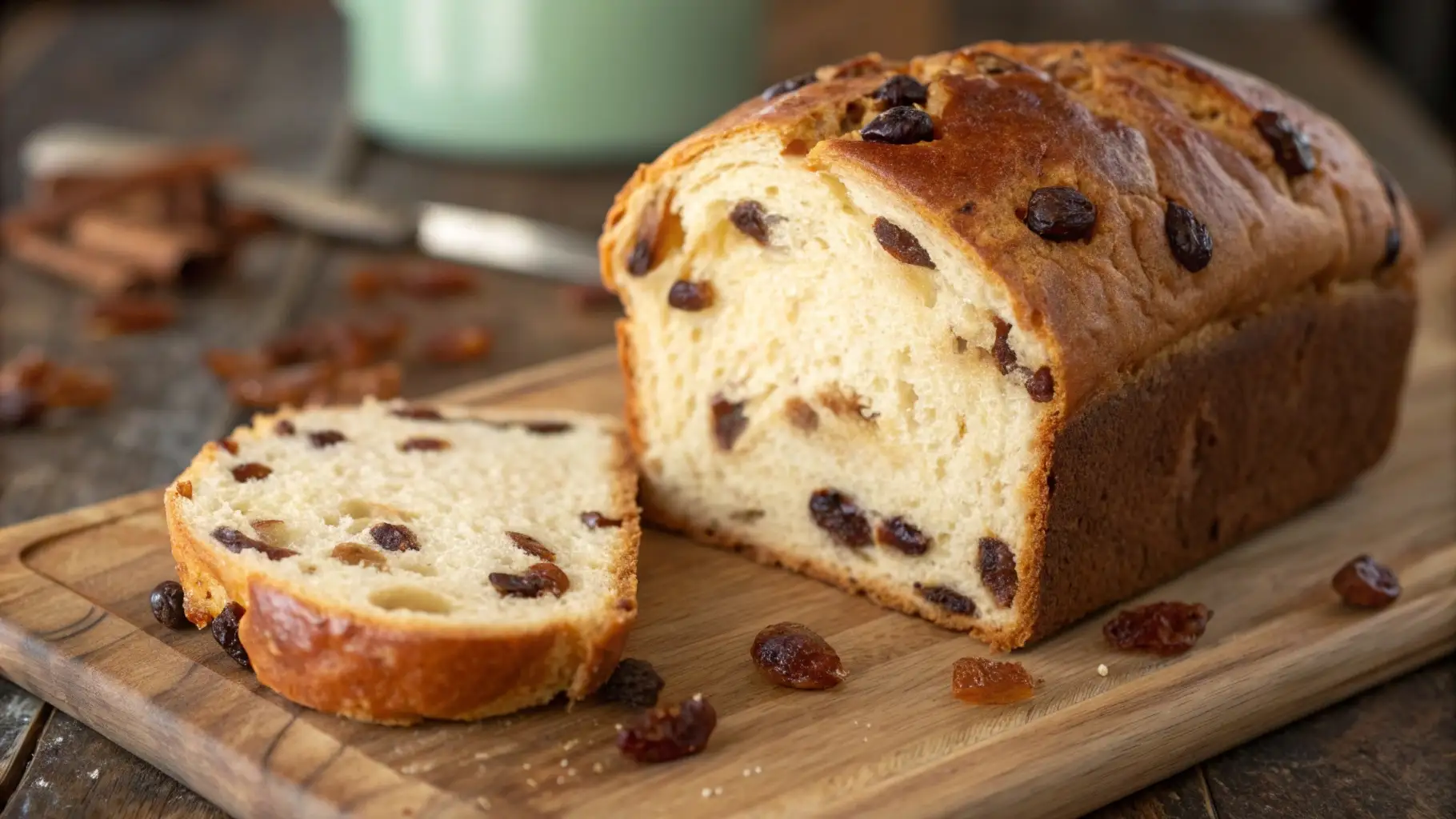
Warm, lightly sweet, and dotted with juicy raisins, this raisin bread is the kind of breakfast that makes mornings feel special. It’s simple to make, comforting to eat, and perfect for toasting with a pat of butter. You don’t need any fancy tools or special skills—just a bowl, a loaf pan, and a little time for the dough to rise.
The result is a soft, tender loaf with a gentle cinnamon aroma and a golden crust. Whether you enjoy it plain or dressed up with cream cheese, this bread turns an ordinary morning into something to look forward to.
What Makes This Recipe So Good
- Simple ingredients, big flavor: Pantry staples like flour, milk, sugar, and cinnamon come together to create a bakery-style loaf.
- Soft, sliceable texture: The crumb is tender and moist, perfect for toast or French toast.
- Kid-friendly and freezer-friendly: It keeps well and toasts beautifully from frozen.
- No stand mixer needed: You can mix and knead by hand in under 10 minutes.
- Balanced sweetness: It’s lightly sweet, so it works with butter, jam, or even savory spreads like cream cheese.
Ingredients
- 3 cups (360 g) all-purpose flour, plus extra for dusting
- 1/4 cup (50 g) granulated sugar
- 1 packet (2 1/4 tsp) instant yeast or active dry yeast
- 1 tsp fine salt
- 1 cup (240 ml) warm milk (about 105–110°F/40–43°C)
- 1/4 cup (60 g) unsalted butter, melted and slightly cooled
- 1 large egg, room temperature
- 1 to 1 1/4 cups (150–190 g) raisins (regular or golden)
- 1 1/2 tsp ground cinnamon
- 1 tsp vanilla extract (optional but lovely)
- 1 tbsp neutral oil or soft butter for greasing the bowl and pan
- 1 tbsp milk or melted butter for brushing the top (optional)
Instructions
- Prep the raisins: If your raisins are dry, soak them in warm water for 10 minutes, then drain and pat dry. This helps keep the bread extra soft and studded with plump fruit.
- Mix the dry ingredients: In a large bowl, whisk together flour, sugar, yeast, salt, and cinnamon until evenly combined.
- Add the wet ingredients: Stir in the warm milk, melted butter, egg, and vanilla.
Mix with a spoon until a shaggy dough forms and most of the flour is absorbed.
- Knead the dough: Turn out onto a lightly floured surface and knead for 7–9 minutes until smooth and elastic. If the dough sticks, dust lightly with flour, but avoid adding too much.
- Fold in the raisins: Gently flatten the dough, sprinkle the raisins evenly, and fold or roll the dough to distribute. Knead lightly just until the raisins are tucked in.
- First rise: Place the dough in a lightly greased bowl, cover with a clean towel or plastic wrap, and let rise in a warm spot until doubled, about 60–90 minutes.
- Shape the loaf: Punch down the dough to release air.
Pat into a rectangle about 8×12 inches. Roll up tightly from the short side, pinch the seam, and tuck the ends under.
- Pan and second rise: Grease a 9×5-inch loaf pan. Place the dough seam-side down in the pan.
Cover and let rise until the top domes 1 inch above the rim, about 35–50 minutes.
- Preheat and bake: Preheat the oven to 350°F (175°C). Brush the top with milk or melted butter if you like a softer, shinier crust. Bake 30–35 minutes, until golden brown and the internal temperature reaches about 190°F (88°C).
- Cool before slicing: Let the loaf cool in the pan for 10 minutes, then transfer to a wire rack.
Cool at least 45 minutes before slicing to keep the crumb soft and even.
How to Store
- Room temperature: Wrap the cooled loaf in foil or store in an airtight container for up to 3 days. Avoid the fridge—it dries the bread.
- Freezer: Slice the loaf, then freeze slices in a zip-top bag for up to 2 months. Toast straight from frozen or thaw on the counter.
- Refresh: If the bread feels a bit stale, toast it lightly or warm slices in a 300°F (150°C) oven for 5–7 minutes.
Why This is Good for You
- Whole ingredients: You know exactly what’s in your bread—no hidden additives.
- Steady energy: Raisins add natural sweetness and small amounts of fiber and iron, while the bread provides satisfying carbs.
- Customizable: You can control the sugar, switch to part whole-wheat flour, or add nuts for healthy fats.
- Comfort factor: A warm, homemade breakfast can set a calm, positive tone for the day.
Common Mistakes to Avoid
- Milk too hot: If it’s hotter than 115°F (46°C), it can kill the yeast.
Aim for warm, not hot.
- Over-flouring the dough: A slightly tacky dough bakes softer. Add just enough flour to keep it workable.
- Skipping the second rise: This step creates a taller, lighter loaf with an even crumb.
- Cutting too soon: Slicing while hot compresses the bread and makes it gummy. Let it cool properly.
- Uneven raisin distribution: Fold the raisins in after kneading instead of at the start to avoid tearing and clumping.
Recipe Variations
- Cinnamon Swirl: Mix 2 tbsp sugar with 1 tsp cinnamon.
After flattening the dough, sprinkle the mixture evenly before rolling up. Adds a bakery-style swirl.
- Whole-Wheat Boost: Swap 1 cup of the all-purpose flour for whole-wheat flour. Add 1 extra tablespoon of milk if needed.
- Golden Raisins + Orange: Use golden raisins and add 1 tsp orange zest for a bright, sunny flavor.
- Nutty Crunch: Fold in 1/2 cup chopped walnuts or pecans with the raisins for texture and richness.
- Dairy-Free: Use almond, oat, or soy milk and replace butter with a neutral oil.
The loaf will still be soft and flavorful.
- Less Sweet: Reduce sugar to 2 tablespoons. Great if you plan to serve with jam or honey.
Explore more irresistible bread recipes you won’t want to miss:
FAQ
Can I use active dry yeast instead of instant yeast?
Yes. If using active dry yeast, stir it into the warm milk with a pinch of sugar and let it sit for 5–10 minutes until foamy.
Then proceed with the recipe.
Do I need a stand mixer for this?
No. Hand-kneading works perfectly and takes less than 10 minutes. If you prefer a mixer, knead on medium-low with a dough hook for about 6 minutes.
Why is my bread dense?
Common causes are cold dough, under-kneading, or cutting the rising time short.
Make sure the dough doubles on the first rise and looks puffy after the second.
Can I make this overnight?
Yes. After the first rise, shape the loaf, place it in the pan, cover, and refrigerate overnight. Let it warm and rise at room temperature for 45–75 minutes before baking.
How do I keep the raisins from burning on top?
If any raisins peek out, gently tuck them into the dough before baking.
You can also tent the loaf with foil during the last 10 minutes if the top browns too fast.
What’s the best way to slice it?
Let it cool fully, then use a serrated bread knife. For even slices, turn the loaf on its side and cut with gentle sawing motions.
Can I make mini loaves?
Absolutely. Divide the dough into two smaller pans and reduce baking time to 22–28 minutes.
Check for a golden top and a 190°F (88°C) center.
Is this bread good for French toast?
It’s excellent. The soft crumb soaks up custard without falling apart. Day-old slices are perfect for this.
In Conclusion
This easy raisin bread is the kind of recipe you’ll keep coming back to—simple steps, reliable results, and warm, homey flavor.
It’s perfect for breakfast, a quick snack, or a cozy afternoon treat with tea. Make one loaf for now and freeze a few slices for busy mornings. With a soft crumb, gentle sweetness, and plenty of raisins in every bite, it turns everyday moments into something a little more special.
Easy Raisin Bread Recipe Perfect Breakfast Treat - Soft, Cozy, and Simple
Ingredients
- 3 cups (360 g) all-purpose flour, plus extra for dusting
- 1/4 cup (50 g) granulated sugar
- 1 packet (2 1/4 tsp) instant yeast or active dry yeast
- 1 tsp fine salt
- 1 cup (240 ml) warm milk (about 105–110°F/40–43°C)
- 1/4 cup (60 g) unsalted butter, melted and slightly cooled
- 1 large egg, room temperature
- 1 to 1 1/4 cups (150–190 g) raisins (regular or golden)
- 1 1/2 tsp ground cinnamon
- 1 tsp vanilla extract (optional but lovely)
- 1 tbsp neutral oil or soft butter for greasing the bowl and pan
- 1 tbsp milk or melted butter for brushing the top (optional)
Instructions
- Prep the raisins: If your raisins are dry, soak them in warm water for 10 minutes, then drain and pat dry. This helps keep the bread extra soft and studded with plump fruit.
- Mix the dry ingredients: In a large bowl, whisk together flour, sugar, yeast, salt, and cinnamon until evenly combined.
- Add the wet ingredients: Stir in the warm milk, melted butter, egg, and vanilla.Mix with a spoon until a shaggy dough forms and most of the flour is absorbed.
- Knead the dough: Turn out onto a lightly floured surface and knead for 7–9 minutes until smooth and elastic. If the dough sticks, dust lightly with flour, but avoid adding too much.
- Fold in the raisins: Gently flatten the dough, sprinkle the raisins evenly, and fold or roll the dough to distribute. Knead lightly just until the raisins are tucked in.
- First rise: Place the dough in a lightly greased bowl, cover with a clean towel or plastic wrap, and let rise in a warm spot until doubled, about 60–90 minutes.
- Shape the loaf: Punch down the dough to release air.Pat into a rectangle about 8x12 inches. Roll up tightly from the short side, pinch the seam, and tuck the ends under.
- Pan and second rise: Grease a 9x5-inch loaf pan. Place the dough seam-side down in the pan.Cover and let rise until the top domes 1 inch above the rim, about 35–50 minutes.
- Preheat and bake: Preheat the oven to 350°F (175°C). Brush the top with milk or melted butter if you like a softer, shinier crust. Bake 30–35 minutes, until golden brown and the internal temperature reaches about 190°F (88°C).
- Cool before slicing: Let the loaf cool in the pan for 10 minutes, then transfer to a wire rack.Cool at least 45 minutes before slicing to keep the crumb soft and even.