
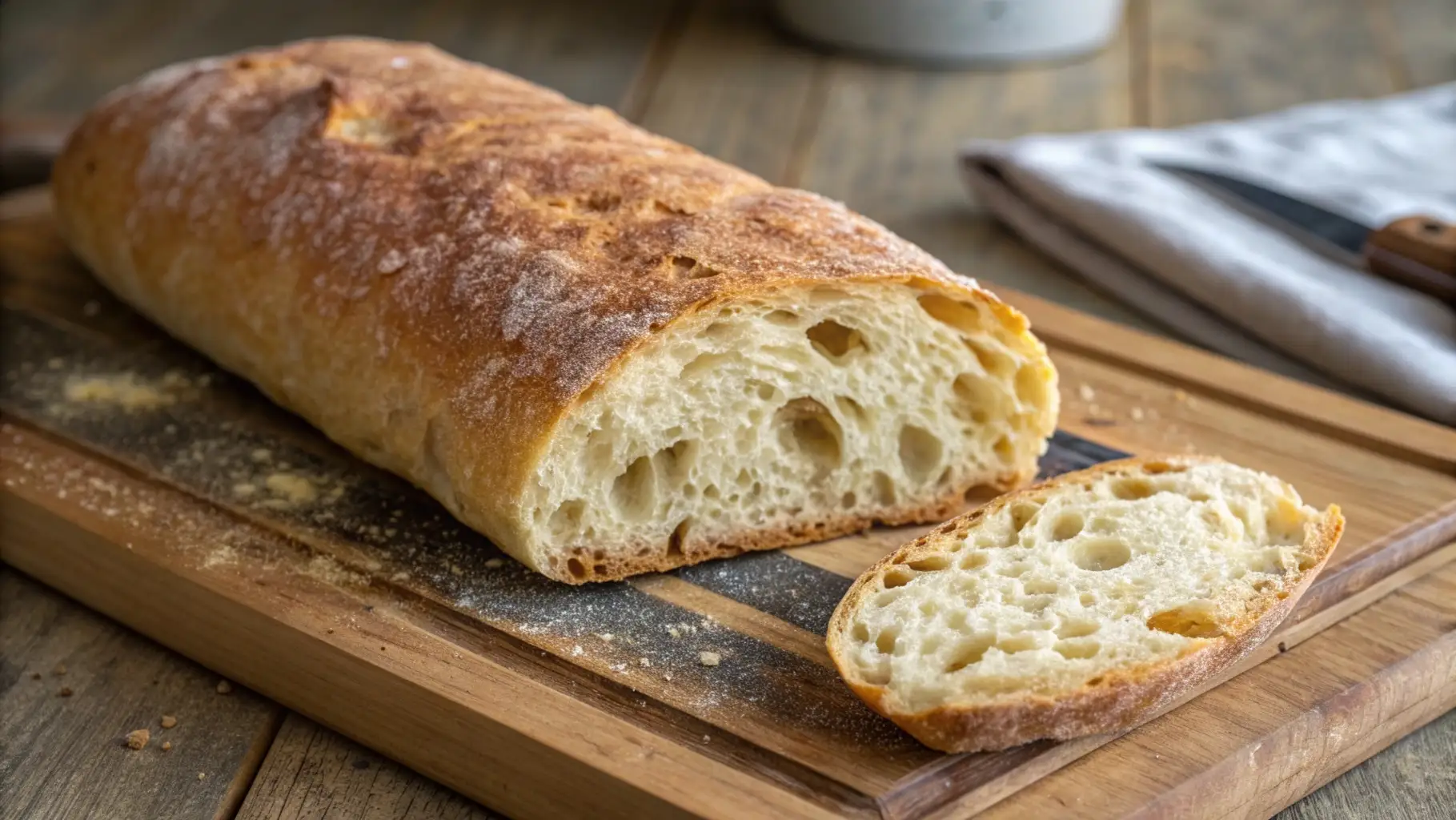
Ciabatta looks fancy, but it’s one of the most forgiving breads you can make at home. This version keeps the ingredients simple and the steps straightforward, so you can get that signature airy crumb and crisp crust without stress. You’ll mix a wet dough, let time and gentle folds do the work, and bake it into rustic loaves that are perfect for sandwiches or dipping in olive oil.
If you’ve been nervous about baking bread, this is a great place to start. The results feel artisan, but the process is beginner-friendly and surprisingly hands-off.
Why This Recipe Works
Ciabatta relies on a high-hydration dough, which creates large holes and a light, open crumb. Instead of kneading heavily, you’ll use stretch-and-folds to gently build gluten.
This method is easier for beginners and keeps the dough airy.
A long, warm rise gives the dough flavor and structure without any special equipment. The loaf bakes at a high temperature to get that thin, crackly crust. With just a few steps and a little patience, you’ll get bakery-style bread at home.
Shopping List
- Bread flour (4 cups / 500 g) – high protein helps with structure and chew
- Warm water (2 cups / 475 ml), about 95–105°F
- Instant yeast (2 teaspoons) – or active dry yeast (2 1/4 teaspoons), see notes in Instructions
- Fine sea salt (2 teaspoons)
- Olive oil (1 tablespoon) – optional, for flavor and easier handling
- Semolina or extra flour for dusting
- Parchment paper – helpful for transferring dough
Instructions
- Make the dough: In a large bowl, whisk together the flour, yeast, and salt.
Add warm water and olive oil (if using). Stir with a spatula until no dry spots remain. The dough will be very wet and sticky—that’s correct.
- Rest (autolyse): Cover the bowl and let the dough rest for 20–30 minutes.
This helps the flour hydrate and makes gluten development easier.
- First stretch-and-fold: With wet hands, grab one edge of the dough, stretch it up, and fold it over the center. Rotate the bowl and repeat 4 times to form a rough ball. Cover and rest 30 minutes.
- Repeat folds: Do 2 more rounds of stretch-and-folds, 30 minutes apart.
Each time, the dough should feel smoother and hold its shape a bit more. Keep your hands damp to prevent sticking.
- Bulk rise: Cover the bowl and let the dough rise in a warm spot for 1–2 hours, or until it’s puffed and roughly doubled. It should wobble like a soft pillow when you jiggle the bowl.
- Prepare the bake setup: Place a baking stone or an inverted sheet pan in the oven and preheat to 475°F (245°C) for at least 30 minutes.
Place an empty metal pan on the lower rack for steam.
- Shape gently: Generously dust your counter with flour or semolina. Carefully scrape the dough onto the floured surface, trying not to deflate it. Dust the top with more flour.
Using a bench scraper, gently coax it into a rectangle about 1 inch thick. Cut into two equal pieces.
- Final shaping: With floured hands, lift each piece and lightly stretch into a longer slipper shape. Don’t press down; keep as much air inside as possible.
Place onto a parchment sheet dusted with flour or semolina, leaving space between loaves.
- Final proof: Cover loosely with a towel and let rest 30–45 minutes, until slightly puffy. Meanwhile, bring 1 cup of hot water to a boil for steam.
- Steam and bake: Slide the parchment with the loaves onto the hot stone or sheet pan. Carefully pour the boiling water into the empty pan below and close the oven quickly to trap steam.
Bake 12 minutes, then remove the steam pan, rotate the loaves, and bake another 10–15 minutes, until deep golden brown.
- Cool completely: Transfer to a rack and let cool at least 45 minutes. Cutting too early can squash the crumb and make it gummy.
Using active dry yeast? Proof it first: mix yeast with the warm water and a pinch of sugar. Let sit 5–10 minutes until foamy, then add to the flour and salt.
Storage Instructions
- Room temperature: Keep the loaf in a paper bag or wrapped in a clean towel for up to 2 days.
Avoid plastic—it softens the crust.
- Freezing: Slice, wrap tightly in foil or plastic, and freeze in a zip-top bag for up to 2 months. Toast straight from frozen or thaw at room temperature.
- Reviving crust: If the crust softens, re-crisp in a 375°F (190°C) oven for 8–10 minutes.
Health Benefits
Homemade bread skips the preservatives and additives you often find in store-bought loaves. You control the ingredients, including the amount of salt and oil.
Using bread flour provides protein that helps structure the loaf, which can make it more satisfying.
Ciabatta is still a carbohydrate-dense food, but pairing it with protein and healthy fats—like eggs, tuna, or olive oil—can help keep you full longer. If you prefer more fiber, you can swap a portion of the white flour with whole wheat or spelt (see variations below).
Pitfalls to Watch Out For
- Too much flour: It’s tempting to add more flour to tame the sticky dough. Resist.
Extra flour tightens the crumb and reduces those big, beautiful holes.
- Rough handling: Pressing or kneading during shaping knocks out gas. Be gentle—lift and stretch instead of pushing down.
- Underproofing: If the dough hasn’t risen enough, the crumb will be tight and the flavor flat. Look for a puffy, jiggly dough.
- Skipping steam: Steam is key for a thin, crisp crust.
Use a hot water pan or spritz the oven walls (if your oven allows it).
- Cutting too soon: Warm bread smells amazing, but slicing early compresses the crumb. Let it cool to set the structure.
Recipe Variations
- Whole Wheat Ciabatta: Replace 25–30% of the bread flour with whole wheat flour. Add 1–2 tablespoons extra water if the dough feels stiff.
- Olive and Herb: Fold in 1/2 cup chopped pitted olives and 1 tablespoon chopped rosemary during the second stretch-and-fold.
Reduce added salt slightly if olives are salty.
- Garlic and Olive Oil: Stir 2 tablespoons olive oil and 1–2 teaspoons finely grated garlic into the dough at the start for a fragrant loaf.
- Sourdough Hybrid: Replace 1 cup (about 225 g) of water and 1 cup (about 130 g) of flour with 1 cup active sourdough starter (100% hydration). Reduce yeast to 1/2 teaspoon and extend rise times.
- Mini Ciabatta Rolls: Divide into 6–8 pieces after the bulk rise. Proof 30 minutes and bake 12–15 minutes.
Perfect for sliders or soup.
Explore more irresistible bread recipes you won’t want to miss:
FAQ
Can I make the dough the day before?
Yes. After the final stretch-and-fold, cover and refrigerate overnight. The next day, let the dough warm up for 45–60 minutes, then shape, proof, and bake.
Cold fermentation boosts flavor and makes handling easier.
What if I don’t have a baking stone?
Use an inverted heavy sheet pan preheated with the oven. It won’t hold heat quite as well as stone, but it still gives a nice oven spring and crust.
How do I know the bread is done?
Look for a deep golden-brown crust and a hollow sound when you tap the bottom. If you have a thermometer, the internal temperature should be around 205–210°F (96–99°C).
Why is my dough so sticky?
Ciabatta is a high-hydration dough.
Stickiness is normal and necessary for the open crumb. Use wet hands and a bench scraper, and dust your surface lightly—but don’t work in too much extra flour.
Can I use all-purpose flour?
Yes, but you may need slightly less water (reduce by 1–2 tablespoons) because protein levels vary. The bread will still be delicious, though the structure may be a bit softer.
How can I add more flavor?
Extend the bulk rise in the fridge overnight, use a small amount of sourdough starter, or add a poolish (equal parts flour and water with a pinch of yeast, fermented overnight) and reduce the yeast in the main dough.
Wrapping Up
Ciabatta might look advanced, but the method is simple: mix a wet dough, fold a few times, let it rise, and bake hot with steam.
With gentle handling and patience, you’ll get an airy crumb and crisp crust that feels straight from a bakery. Use it for sandwiches, dunk it in soup, or tear off pieces for olive oil and balsamic. Once you’ve made it once, you’ll want to bake it again and again.
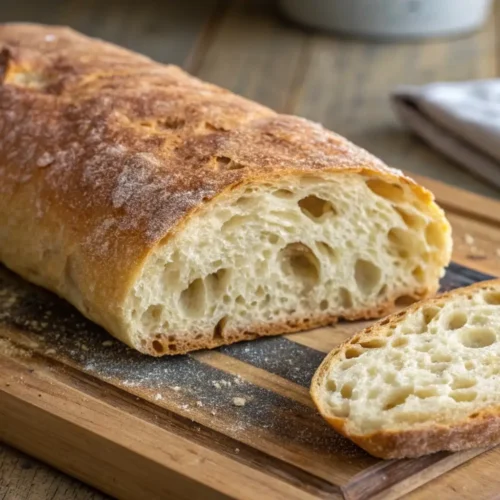
Easy Ciabatta Bread Recipe for Beginners – Light, Airy, and Foolproof
Ingredients
- Bread flour (4 cups / 500 g) – high protein helps with structure and chew
- Warm water (2 cups / 475 ml), about 95–105°F
- Instant yeast (2 teaspoons) – or active dry yeast (2 1/4 teaspoons), see notes in Instructions
- Fine sea salt (2 teaspoons)
- Olive oil (1 tablespoon) – optional, for flavor and easier handling
- Semolina or extra flour for dusting
- Parchment paper – helpful for transferring dough
Instructions
- Make the dough: In a large bowl, whisk together the flour, yeast, and salt.Add warm water and olive oil (if using). Stir with a spatula until no dry spots remain. The dough will be very wet and sticky—that’s correct.
- Rest (autolyse): Cover the bowl and let the dough rest for 20–30 minutes.This helps the flour hydrate and makes gluten development easier.
- First stretch-and-fold: With wet hands, grab one edge of the dough, stretch it up, and fold it over the center. Rotate the bowl and repeat 4 times to form a rough ball. Cover and rest 30 minutes.
- Repeat folds: Do 2 more rounds of stretch-and-folds, 30 minutes apart.Each time, the dough should feel smoother and hold its shape a bit more. Keep your hands damp to prevent sticking.
- Bulk rise: Cover the bowl and let the dough rise in a warm spot for 1–2 hours, or until it’s puffed and roughly doubled. It should wobble like a soft pillow when you jiggle the bowl.
- Prepare the bake setup: Place a baking stone or an inverted sheet pan in the oven and preheat to 475°F (245°C) for at least 30 minutes.Place an empty metal pan on the lower rack for steam.
- Shape gently: Generously dust your counter with flour or semolina. Carefully scrape the dough onto the floured surface, trying not to deflate it. Dust the top with more flour.Using a bench scraper, gently coax it into a rectangle about 1 inch thick. Cut into two equal pieces.
- Final shaping: With floured hands, lift each piece and lightly stretch into a longer slipper shape. Don’t press down; keep as much air inside as possible.Place onto a parchment sheet dusted with flour or semolina, leaving space between loaves.
- Final proof: Cover loosely with a towel and let rest 30–45 minutes, until slightly puffy. Meanwhile, bring 1 cup of hot water to a boil for steam.
- Steam and bake: Slide the parchment with the loaves onto the hot stone or sheet pan. Carefully pour the boiling water into the empty pan below and close the oven quickly to trap steam.Bake 12 minutes, then remove the steam pan, rotate the loaves, and bake another 10–15 minutes, until deep golden brown.
- Cool completely: Transfer to a rack and let cool at least 45 minutes. Cutting too early can squash the crumb and make it gummy.